
How to Hire Someone in Japan to Go With You for a Day: Options, Costs and Rules
Short answer
- To have someone in Japan go with you for a day, you have five realistic options: free public help, volunteer guide groups, freelance marketplaces, licensed guides or interpreting agencies, and local-partner platforms such as jpwork hub.
- Published rates give a sense of cost: licensed guides from about ¥25,000–35,000 for a full day, and agency interpreters from ¥50,000 to ¥130,000 per full day. The person's train fares, meals and admission fees are often extra.
- A paid companion can walk with you, interpret, help you shop, view a property or visit an office. Under Japanese law they cannot, for a fee, drive you in their own car, book your trains or hotels, prepare documents for a government office, or negotiate a legal dispute for you.
- Start by writing down the date, area, hours, what you need done and the language. Then pick the option that matches how much is at stake.
Your options at a glance
| Option | Typical cost | Good for | Not good for |
|---|---|---|---|
| Japan Visitor Hotline (JNTO) | Phone line, no booking | Emergencies, illness, disasters, general tourist questions, 24 hours a day | Coming with you in person or interpreting on a three-way call |
| Volunteer guide groups | Some are free; some ask you to cover the guide's transport | Sightseeing walks in a city | Errands, business or last-minute plans (several ask for two weeks' notice) |
| Freelance marketplaces (Fiverr, Upwork and others) | Set by each seller | Remote tasks, and sellers who also offer in-person help | Checking who you will meet; few sellers offer in-person work |
| Licensed guides and interpreting agencies | About ¥25,000–35,000 (guide) to ¥50,000–130,000 (agency interpreter) per full day | Formal tours, important meetings, conferences | Small everyday errands on a budget |
| jpwork hub | Set by each partner; the platform fee is included | A local who comes with you for a half or full day: shopping, viewings, office or factory visits, interpreting | Conference interpreting with equipment; emergencies |
Free help comes first
The Japan National Tourism Organization (JNTO) runs the Japan Visitor Hotline: 050-3816-2787 (from overseas, +81-50-3816-2787). It answers 24 hours a day, 365 days a year, in English, Chinese and Korean. It helps with accidents, illness, natural disasters and general tourist information (JNTO: Japan Visitor Hotline). JNTO also notes that, as a general rule, it does not provide three-way interpretation or make reservations for visitors (JNTO: Guide for when you are feeling ill). So it can tell you what to do, but it will not come with you.
JNTO also lists volunteer guide groups around Japan (JNTO: List of Volunteer Guides). Costs differ by group: some walks are free, while others ask you to pay the guide's transport. You contact each group yourself, and several ask for at least two weeks' notice. JNTO does not arrange placements and takes no responsibility for problems during these activities.
What paid help costs
There is no national rate. Two published examples (as of November 2026):
- Licensed guides (Okinawa): ¥25,000–35,000 for a full day (8 hours) and ¥20,000–30,000 for a half day (4 hours). Transport, meals and overtime are not included (Okinawa Convention & Visitors Bureau).
- Agency interpreters: ¥50,000–130,000 per interpreter for a full day and ¥35,000–91,000 for a half day, depending on rank. The entry rank is described as suited to reception desks, airport escorts and exhibition stands (Japan Convention Services).
On top of the fee, plan for the companion's train or bus fares during the day, their meal if you eat together, admission fees, and overtime. Japan has no tipping custom (JNTO), so agree on the full price in advance. For sightseeing guides in more detail, see how much a private tour guide costs in Japan.
What a companion can do for you
- Shopping: ask staff about stock, sizes and condition, and help with the tax-free steps at the counter.
- Viewing before you buy or rent: visit a shop, a used item or a property with you, or for you when you cannot come. See viewing property in Japan from overseas.
- Clinics and hospitals: go with you and interpret at the reception and with the doctor. JNTO's site lets you search for medical institutions by area and language first (JNTO). In an emergency, call 119.
- Offices and counters: come to a ward office, bank or phone shop, explain the steps and interpret.
- Business visits: attend meetings, factory tours and trade shows. See how to hire a business interpreter in Tokyo.
Four things a paid companion cannot do
These rules are easy to miss, and few English guides mention them. The companion can still come with you and interpret. They just cannot do the following as a paid service.
| Task | Who can do it | Rule |
|---|---|---|
| Drive you in their own car for payment | A taxi, a hired car with a professional driver, or a rental car you drive | Private cars may not carry people for a fee, except in limited cases (Road Transport Act, Art. 78) |
| Book your trains, hotels or tours as a business | You, or a registered travel agency | Requires travel agency registration (Japan Tourism Agency) |
| Prepare documents to submit to a government office, for a fee | An administrative scrivener (gyoseishoshi) | Reserved for gyoseishoshi (Gyoseishoshi Act, Art. 1-3 and 19) |
| Negotiate a dispute or settlement on your behalf, for a fee | A lawyer (bengoshi) | Reserved for lawyers (Attorney Act, Art. 72) |
The links above go to the Japanese text of each law. For more on the first two rules, see travel agency rules and unlicensed taxis.
How to book in five steps
- Write down the day: date, area, meeting point, start and end time, and each task.
- Decide the level: a friendly local is enough for shopping or a walk. For a contract, a medical decision or a negotiation, choose an experienced interpreter.
- Ask what the price includes: the companion's transport and meals, overtime and the cancellation rules.
- Book transport and hotels yourself: if you need a car, use a taxi or hire car.
- Send details in advance: addresses, names of shops or offices, and any documents you will bring.
Using jpwork hub for a day
jpwork hub connects visitors with vetted people living in Japan, called partners. Partners set their own prices, and the platform fee is already included in the price you see.
- Post a request: enter your dates, area, tasks and budget. Partners who can help apply, and you choose one. Posting is free.
- Ask one partner directly: if you like a partner but none of their plans fits, use "Ask this partner" on their profile. You do not need to enter a budget. Once the partner accepts, you can message each other right away, and the partner proposes a plan after you talk. This option was added in November 2026.
- Pay online: by card (Visa, Mastercard or American Express) in Japanese yen. If a partner cannot provide the service for reasons on their side, you get a full refund.
When this is not the right choice
- Emergencies: call 119 (fire and ambulance) or 110 (police), or the Japan Visitor Hotline.
- Conferences: simultaneous interpreting needs a team and equipment from an interpreting agency.
- Simple directions: a translation app, a tourist information center or the hotline may be enough. You may not need to hire anyone.
FAQ
Can a companion meet me at the airport?
Yes. They can meet you at arrivals and travel with you by train, bus or taxi. They cannot drive you in their own car for payment, and you pay your own fares.
Can I hire someone for just two or three hours?
Often, yes. Many guides and partners offer half-day or shorter plans. Check the minimum hours, and whether travel time to the meeting point is charged.
Can I send someone to do a task without me?
For some tasks, yes, such as checking an item in a shop or viewing a property and sending photos. Tasks that need your identity, such as opening a bank account or signing a contract, need you to be there.
How do I know the person is safe to meet?
Meet in a public place first and keep your payments and messages on the platform. On jpwork hub, partner profiles show the status of identity checks, and partners sign a non-disclosure agreement with the operator when they register.
Sources: JNTO, Japan Convention Services, Okinawa Convention & Visitors Bureau, e-Gov law database. Information as of November 19, 2026. This article is general information, not legal advice.
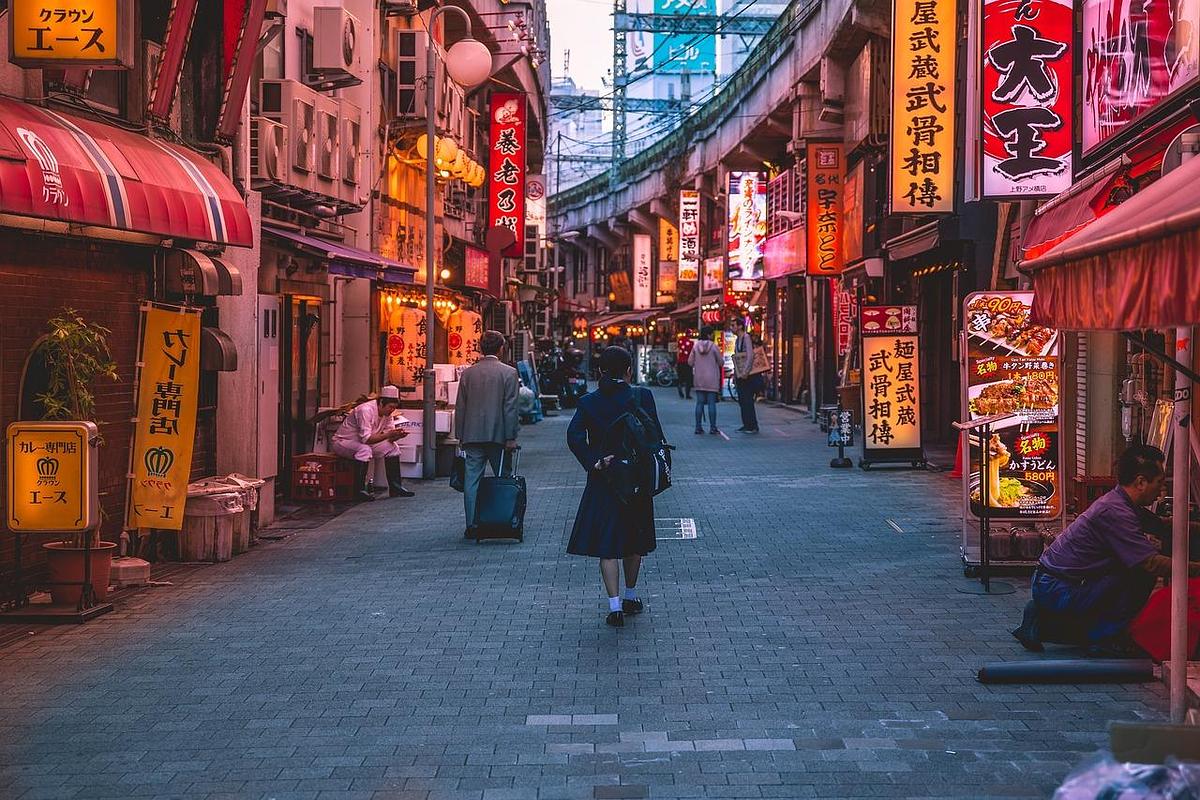
Photo: A traveler with a suitcase on a shopping street in Japan, ANTHR_Photoblog / Pixabay License (Pixabay).